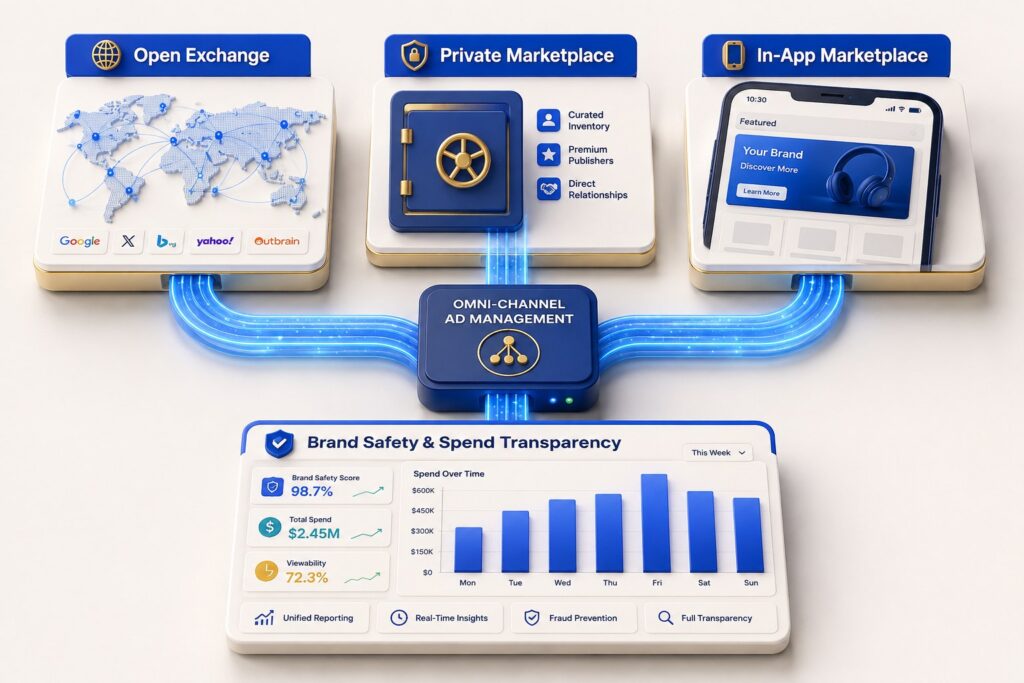
Every advertising campaign eventually runs into the same tension: reach versus control. Buy purely on the open exchange and you get scale, often at a lower price, but with less certainty about exactly where your ad actually appeared. Buy through more curated inventory and you trade some of that reach for a much clearer picture of context, placement quality, and brand safety. For brand advertisers specifically, that trade-off deserves more attention than most planning documents give it.
This isn’t another explainer on programmatic basics. It’s about a decision brand marketers face constantly and rarely get straight advice on: when does moving budget out of the open exchange and into more controlled buying environments actually pay off, and when is it just added complexity for marginal benefit.
Why the Open Ad Exchange Isn’t Always the Right Default?
The open ad exchange auctions impressions to the highest qualifying bid in real time, pulling inventory from a huge pool of publishers and apps. That scale is genuinely valuable for performance-driven campaigns chasing volume. But brand advertisers running an advertising campaign built around perception, not just clicks, run into a specific problem here: the open exchange doesn’t guarantee you know exactly which app or site served your ad, especially across long-tail inventory sitting deep in the supply chain.
For a performance campaign optimizing toward last-click conversions, this ambiguity matters less. For a brand campaign where placement context directly shapes how the ad is perceived, it matters considerably more. Nobody wants a premium product ad appearing next to content that undermines the message, and that risk climbs the deeper you buy into unfiltered open exchange inventory.
What Does a Private Marketplace Actually Change?
A private marketplace usually shortened to PMP, narrows the auction to a pre-approved group of buyers bidding on inventory a publisher has specifically made available to them, often at negotiated or floor pricing rather than fully open competition. The practical benefit for brand advertisers is straightforward: you know which publishers are in the deal, you can negotiate placement quality upfront, and you get much tighter control over brand adjacency than open-exchange buying allows.
The trade-off worth being honest about: PMP deals typically carry a premium over open exchange pricing, and reach is inherently narrower because the publisher pool is curated rather than unlimited. That’s not a flaw, it’s the actual mechanism creating the value but it means PMP buying makes sense for campaigns where placement certainty justifies the cost, not for every campaign by default. Treating a private marketplace as automatically superior to open buying, regardless of campaign goal, is a common and expensive misjudgment.
| Buying Method | Reach | Placement Control | Typical Use Case |
| Open ad exchange | Very high | Limited | Performance campaigns prioritizing scale and cost efficiency |
| Private marketplace | Moderate, curated | High | Brand campaigns needing placement certainty and adjacency control |
| Programmatic guaranteed | Fixed, negotiated | Very high | Premium placements with guaranteed impression volume |
| In-app ad marketplace | High, mobile-specific | Varies by SDK/integration quality | Mobile-first brand or performance campaigns |
The In-App Ad Marketplace Has Its Own Rules
Mobile presents a genuinely different set of considerations than desktop or web display, and this is where a lot of brand advertisers underestimate the complexity. An in-app ad marketplace operates through SDK integrations rather than browser-based tags, which changes how viewability, fraud detection, and even basic ad verification actually work. App-ads.txt, the mobile equivalent of the web’s ads.txt standard, has become a baseline requirement for confirming inventory legitimacy, yet a surprising number of advertisers still don’t check for it before buying in-app placements at scale.
Viewability standards also differ meaningfully in-app. A banner sitting below the fold in a mobile game behaves differently than the same format on a news site, and fraud patterns specific to app environments SDK spoofing, ad stacking within apps require detection methods that don’t map directly from web-based fraud prevention. Brands running significant budgets through in-app inventory without accounting for these differences are often buying impressions that look fine in a report but never had meaningful viewer attention behind them.
How Gamoshi Approaches This Trade-Off?
This is where an omni-channel platform’s structure actually matters practically, rather than just as a feature list. Gamoshi supports both open exchange buying and private marketplace deal structures across display, video, and in-app inventory from a single platform, which means brand advertisers aren’t forced to manage separate vendor relationships and separate reporting dashboards just to run a blended strategy across an advertising marketplace that spans open and curated inventory simultaneously. Real-time transparency into where spend is actually landing, whether that’s an open exchange auction or a negotiated PMP deal, is the detail that lets a brand marketer justify the premium of curated buying with actual data rather than a general sense that it “feels safer.”
Final Thoughts
Structuring an advertising campaign around the right mix of open exchange, private marketplace, and in-app inventory isn’t about picking one buying method and sticking with it everywhere. It’s about matching the buying environment to what the campaign actually needs, scale and efficiency from the open exchange where that’s the priority, and placement certainty from a private marketplace or in-app-specific safeguards where brand perception is genuinely on the line.
FAQ
1. Could a private marketplace be more costly than the open ad exchange?
In most cases, yes, because PMP deals involve pre-selected inventory with direct access. However, the premium ensures that the ads will be placed where the open exchange can’t guarantee.
2. How do in-app ads differ from regular display ads?
In-app ads make use of SDK implementations and not the tag of the browser, which changes the viewability and has an impact on fraud detection and advertisement verification.
3. Should all campaigns use PMP instead of the open exchange?
No. All ads that are judged by performance may end up doing better through the open exchange, while ads that revolve around brands wanting to get reliable assurance of placement might see more perks from PMP deals.